- Optimizer
- Posts
- The Signal Inside The Signal
The Signal Inside The Signal
What 37 Responses from a 196-Person Health Group Reveal About the Future of Longevity Intelligence.

Fellow Optimizer
09 Feb

There's a WhatsApp group that operates like a quiet Harvard longevity think tank. No influencer posturing, no supplement affiliate codes, no algorithm-baited health content. Just 196 people — HBS alumni, Harvard Law and College graduates, physicians, PhD scientists, elite athletes, special forces personnel, operators, and high-flying founders — exchanging research, anecdotes, and strategies designed to close the gap between healthspan and lifespan. The group is called Optimization. And recently, I asked a simple question.
Has your health measurably improved since joining?
Thirty-seven members responded. That's an n=37 dataset from a 196-person population — a 19% response rate, which in the context of a private, invite-only group operating across 14 countries and multiple time zones, is meaningful. Here's what the data says, and more importantly, what it implies.
Of the 37 respondents, 28 reported measurably improved health outcomes. Seven reported that their health remained the same despite the insights shared. One person was too new to assess. One reported being worse off or disengaged entirely. That's a 76% self-reported improvement rate among people who were already, by most conventional standards, operating at a high level. These are not sedentary knowledge workers discovering the gym for the first time. These are people who already had access to concierge medicine, advanced diagnostics, and personal training. The delta here is informational, not infrastructural. What changed was what they knew, when they knew it, and how they applied it.

The geographic distribution of the data is instructive. India led in raw participation with 10 respondents (the largest single-country cohort) but showed a split: six reported improvement while four reported the same outcomes despite engagement. The United States, with seven respondents, delivered the strongest positive signal: 100% reported measurable improvement. Respondents from Turkey, Spain, Pakistan, Brazil, the Philippines, and Italy — all single-respondent countries — each reported improvement. South Africa and Uruguay each reported no change. Mexico provided the sole "worse / don't interact" response.

When grouped by cultural region, the patterns become more interesting. South Asia, which includes India and Pakistan, had the highest engagement volume at 11 respondents but also the highest proportion — roughly 36% — who reported no improvement. This may reflect cultural enthusiasm for wellness communities that doesn't always translate into protocol adherence, or it may reflect different baselines and expectations for what "improvement" means. North America's near-universal improvement may reflect better access to the specific supplements, labs, and interventions discussed in the group — or it may reflect a cultural bias toward self-reporting positively. Europe's small sample of three all reported improvement. Latin America was split: Brazil improved, Uruguay didn't, and Mexico disengaged (the polled individual later deleted their entry)

At the US state level, Virginia and Michigan were both identified as improved. In India, Tamil Nadu, Delhi, and Delhi/NCR reported improvement, while other Delhi respondents, Andhra/Telangana, and Maharashtra reported staying the same. These sub-national patterns hint at something worth studying further: the role of local health infrastructure and cultural norms in translating shared research into personal outcomes.
What none of this data captures — and what matters most — is the counterfactual. What would these 37 people have done without the group? The Optimization group chat regularly surfaces research and strategies weeks or months before they reach mainstream fitness or longevity media.
The protocol I developed and published — one that costs a person around $9,500 to administer over two months and has a 50% attrition rate in the first sixty days but 0% attrition beyond that — was born inside this group. The discussions around mitochondrial health, cognitive resilience, anti-cancer strategies, and metabolic flexibility that eventually became essays on Optimizer were pressure-tested here first. The group is the laboratory. The newsletter is the published finding.
And that brings me to what's next. I have had calls to expand the group beyond its current borders. With a 22 person wait list, here is how I plan on solving that while maintaining the integrity of the group.
In March, I'm launching a donor-only email list, a deeper layer of the work that powers both the Optimization group and the public Optimizer newsletter. This donor-only monthly letter will deliver research, protocols, and analysis that goes beyond what's appropriate or possible in a free public format. It's for people who take this work seriously enough to fund it. It will also provide access to a network of medical professionals that
Optimization One-Time $1,000 Donation (current members) → Here
Optimization Premium $10,000 Donation (newly approved members) → Here
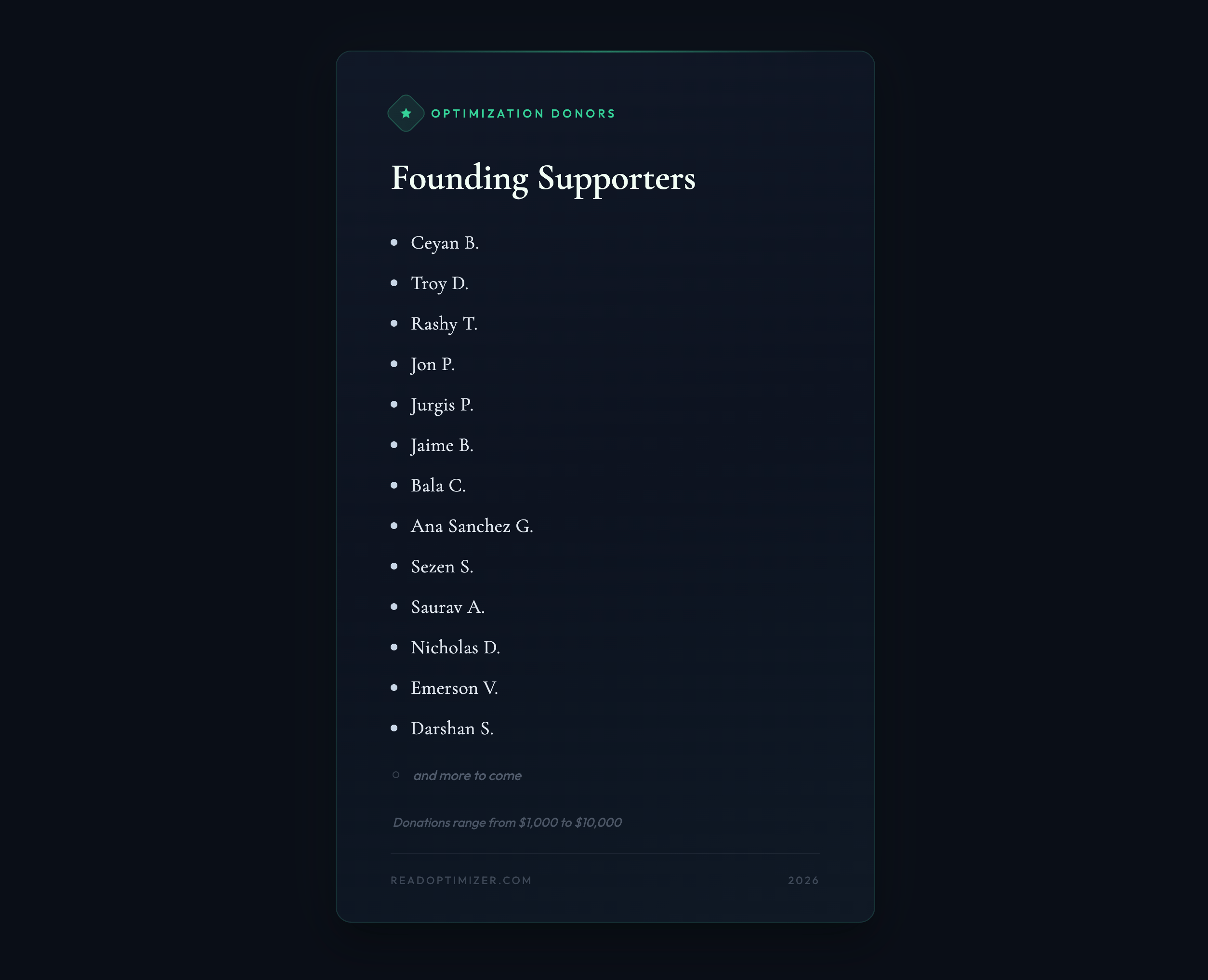
For current Optimization group members, supporting this effort sustains the ecosystem you already benefit from. The group will not expand beyond 220 members. Yes, this is a filter. The group's value is a function of who is in it: their rigor, their curiosity, their willingness to share what they've learned at the highest levels of professional and physical performance.

Where most of my personal work gets done.
Thirty-seven people answered a poll. Twenty-eight said their health got better. That's not a clinical trial, it's not peer-reviewed, but it is a signal (from a population that already had every advantage) reporting that a curated flow of intelligence made them measurably healthier. The gap between health span and lifespan is closing. The question is whether you're in the room where research is curated, shared, critiqued, dismissed, used, and - maybe - proven successful.

Reply