- Optimizer
- Posts
- Part II: The Convergence Protocol
Part II: The Convergence Protocol
No single culture solved longevity. But each solved a piece. Western discipline. European cardio. Eastern stillness. Mediterranean diet. Asian movement. One protocol.

Fellow Optimizer
11 Feb
There's a WhatsApp group that operates like a quiet Harvard longevity think tank. No influencer posturing, no supplement affiliate codes, no algorithm-baited health content. Just 196 people — HBS alumni, Harvard Law and College graduates, physicians, PhD scientists, elite athletes, special forces personnel, operators, and high-flying founders — exchanging research, anecdotes, and strategies designed to close the gap between healthspan and lifespan. The group is called Optimization. And recently, I asked a simple question.

Has your health measurably improved since joining?
I ran a poll in our Optimization WhatsApp group a few weeks ago. Simple question: since joining, has your health measurably improved?
38 people responded across 15 countries. 76% said yes. But the interesting part wasn't the number — it was the pattern hiding underneath it.
When I mapped responses by phone country code and name origin, something jumped out. The people reporting real, measurable improvement weren't clustered in one culture. They were scattered across continents. But some reporting no change, despite having access to the same insights, the same protocols, the same group — were disproportionately from cultures where wellness was a different way of life. Familiarity, it turns out, isn't the same as practice.
I was talking about this with Dev Pragad, CEO of Newsweek, who I think is one of the best living examples of what I'm about to describe — a middle-aged man of Indian descent who has consciously adopted practices from outside his own cultural defaults. Not because his culture got it wrong. Because no single culture got it all right.
That conversation, combined with the data, led me to a framework I'm calling The Convergence Protocol. The premise is simple: the person most likely to optimize their health
span is the one willing to borrow from everywhere and belong to nothing. Five cultures. Five disciplines. One approach.
Here it is.
The biggest barrier to optimization isn't access to information. It's cultural gravity, the pull of what feels normal. The Indian respondent who grew up around yoga but never does it. The American who tracks every biomarker but hasn't sat still for ten minutes in a decade. The European who cycles everywhere but eats like convenience is a virtue.
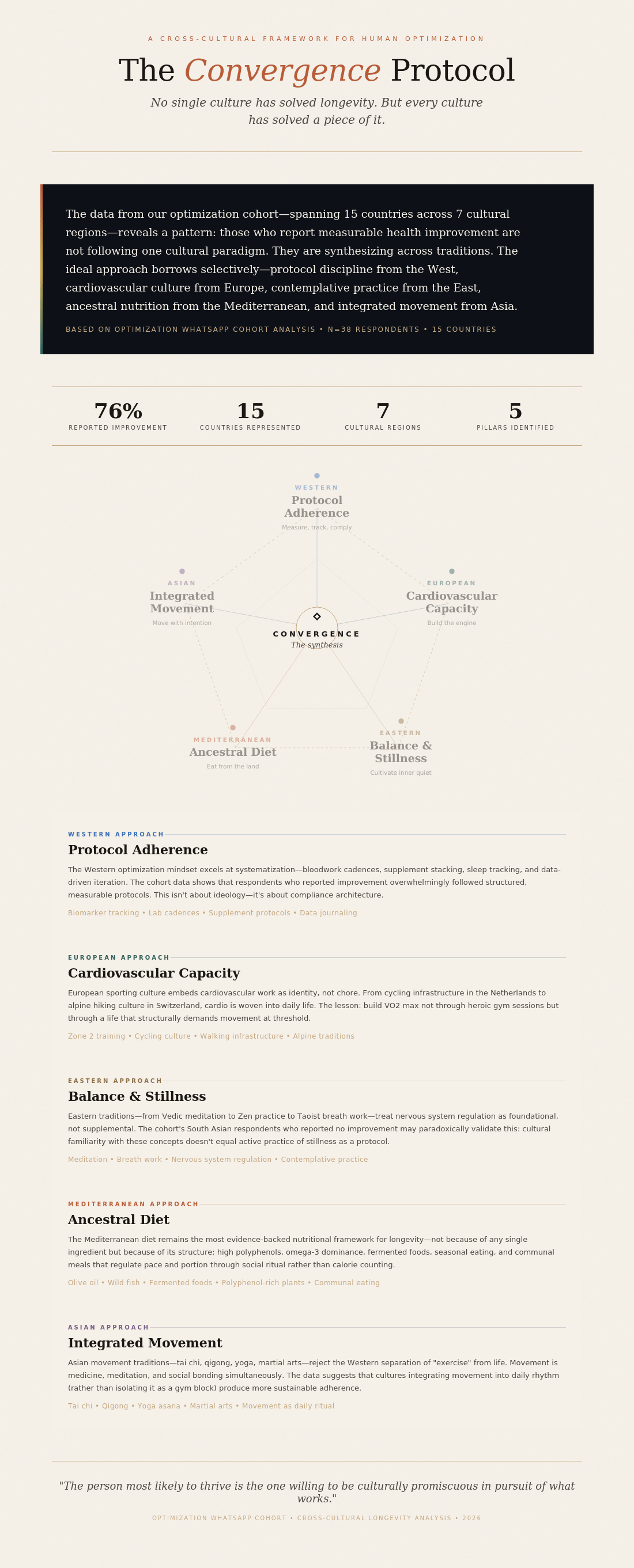
We all have blind spots shaped by where we come from. The data from this group — small as it is — suggests that the people making real progress are the ones who've learned to see their own culture from the outside. They take what works. They leave what doesn't. And they refuse to let identity be the reason they skip the thing that would actually help.
No culture solved the whole puzzle. But the pieces are all on the table. The Convergence Protocol is just the willingness to assemble them.

Reply